I’ve spent lots of time in NYC. And, when crossing the street, I’ll be honest, I have never really seen the yellow traffic light as “hold up.” I usually believe I am in some kind of hurry.
It’s not something I thought much about until a friend visited from out of town – he had never been to NYC before. “Oh! I get how the traffic lights work here – the yellow light doesn’t actually mean caution.”
I wasn’t following… “It means run like hell before the light turns red.”
Run like hell before the light turns red. As an executive coach, I have seen this play out in a number of ways through the years. And, I bet you could add to this list:
- I need to get this thing done because I plan to leave my job in two years.
- I want to grow our impact by 5x before I retire in three years.
- This re-organization is long overdue – I just have to get it done.
- This program has never really been successful – we have to fix it fast.
- How quickly can we get these union negotiations done and get back to the real work?
- I can’t bear to look at the wait list of people who want our services – we need to double staff asap!
Because of this sense of urgency, we often focus on crossing the finish line as quickly as we can without thinking about the impact of the journey on the runners. In the process, we forget two important things:
- Change involves feelings
- Time is actually your friend
And these two items are connected. Allow me to demonstrate:
You are a new executive director, and you arrive at an organization that is all about A. You have a vision for it to be B. They are both aligned with the origin story and the mission of the organization, but B represents “different” or “innovation.” The folks already on the bus are quite attached to A and believe in it. In your efforts to move to B quickly, you end up sending this message: “Enough already with A!” How do you think the A people feel? Dismissed? Threatened? Angry? Yes, yes, and yes…
As part of the transition, let’s say you delegate the leadership of an initiative to a senior person on your team. You are clear about the outcome. But you don’t take time to have a thoughtful conversation about the HOW, the principles you want to guide the process that leads to the outcome. Well, without that time spent at the outset, you have not set your senior person up to succeed. That time? It’s your friend. To kick around how the process will play out, to talk about the “what ifs” – this is the kind of direction that can make all the difference.
The strategic shifts from A to B require a lot of time spent up front. I have some big news for you: your staff and your board are not inside your head. So they reach their own conclusions about what it is you are looking for. And this is what they hear. Our leader:
- Believes that A is broken and that we have been wasting our time.
- Thinks that A would be better with different people.
- Is arrogant and just wants B because they want to be seen as a change agent.
- Doesn’t get that A is part of the origin story, and if we go to B, we stray too far from the DNA of our organization.
These are all reasonable thoughts to have if no one has taken the time to navigate them, to talk through how A and B are, in fact, true to the origin, or what B will make possible (thus exciting the team about the change). We just need to take the time to think through what might happen, how someone might feel, the pros and cons, and the what-ifs.
Oh, and then there is just plain caring. I worked with a crisis intervention organization, and there were a few quiet rooms set aside for folks on the hotline to decompress after a rough hotline call. The spaces were used, and they were cozy and enabled team members to just breathe. In my effort to ensure that staff leaders stay close to the work AND illustrate care for their team, I encouraged the E.D. to knock softly on the door of one of these rooms every day and simply say, “Just checking in on you to see if you are ok. I know the work is hard. I’m really grateful for you.” If it led to conversation, great. If not, that was ok too.
I know the E.D. did, in fact, do this from time to time, and when they did it, it was meaningful all around. But when you are in back-to-back meetings about well, stuff, it’s hard to make the time to show you care, isn’t it?
Stephen Covey, author of the 7 Habits of Highly Effective People, reminds us to “start with the end in mind.” I have been known to say that often.
But as I write this, I realize that the “end” is more than just a KPI, a metric. Thinking about the HOW before you even start matters. A lot.
You have to take time to make sure the process is well thought out and given enough time and emotional space. How should the process feel? What kind of leadership development opportunity might this present to a team member? What might objection questions be, and how can you anticipate them?
I usually end blog posts with advice, but this time I’m tossing it right here because I want the end with a story.
- Get What is In Your Head OUT of Your Head. If you are going to make a change in your organization, use a thought partner (ideally your leadership team) to talk through all the implications, how folks will feel, what and how often to communicate, and most importantly, spread your enthusiasm so that folks can get as excited as you are about what the change will make possible.
- Take Time to Care. Your organization may be in the business of changing laws, lives, hearts, and minds, but for people who work in your organization, change can be hard. More importantly, manage people in three dimensions – this was the biggest lesson I learned in moving from the corporate world to the land of the nonprofits. Take the time to find out how they are doing, what books they are reading. I use a Yiddish term for this activity – it’s called “kibbitzing,” but it sells the activity short. It’s about authenticity, humanity, and caring.
And now I get to tell the story that ignited this post. My wife suggested I write a post about this story, and when you read it, you’ll see that I did.
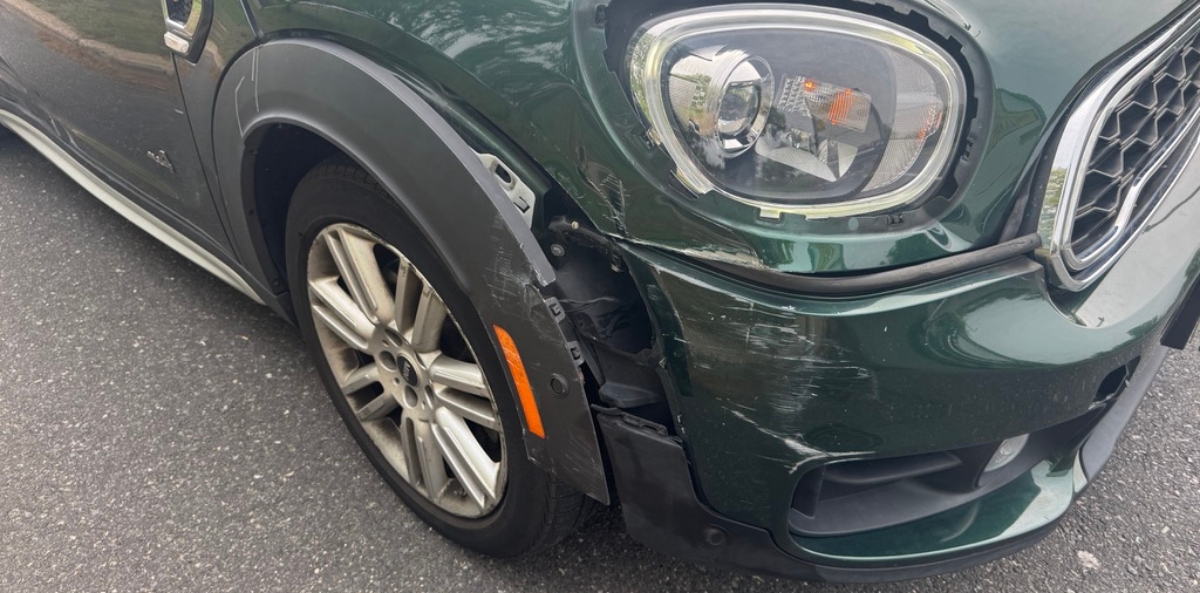
I was coming through a toll booth on the NJ Turnpike in my Mini Cooper and slowly making my way to the right, to the on ramp to Route 73 to Philadelphia to spend time with my two-week-old grandson. I was not rushing – in fact, there was a lot of traffic negotiating these on-ramps, so I was at a standstill. And then a big old tractor-trailer, also moving slowly, just cut right in front of me, tearing off my fender, smashing my headlight, and leaving all kinds of scratches. No one was hurt.
A man pulled over to the shoulder, put on his hazards, and waved at me and the truck driver to join him there. I had no idea who this guy was, but I needed to check the damage and tell the dude driving the truck that he was at fault. And of course, he needed to tell me that I was at fault.
The man in the sedan said, “Call 911, I got you.” I did, and he did. While we waited for the cops, I learned about this guy and where he worked. He took the time (maybe 20-30 mins), stayed on the scene till the cops arrived, and took his witness statement – a statement that will save me about $3,500.
Later that day, I tracked him down online and wrote him a note of thanks, not expecting one in return. But I got one. I share both notes with you, not just because my wife thought you should read them, but because I want the message to sink in.
Slow down and take the time to care.
Here’s my note to Mario
Mario.
We met yesterday at the toll booth at exit 4 of the NJ Turnpike.
You did something most people just don’t do.
You could have kept driving and minded your own business.
Instead you minded mine.
And I just wanted to say thanks. You saw what happened. You pulled over. You directed traffic to get my Mini and a huge tractor trailer truck over to the shoulder.
And you stayed…. You spoke to the cops. You were a witness to back me up. It got me thinking. Would I have done the same? And I honestly don’t know if I would have.
But I sure will going forward.
Thank you for advocating for me and thank you for taking an extra 30 mins out of your day. There was a study a few years back that proved quite conclusively that the biggest factor impacting whether or not someone helps someone else is just one thing. TIME. If people are in a hurry, they don’t stop to help.
Thank you for taking the time to stop. Thank you for doing the right thing.
Warm regards,
Joan
Here’s Mario’s email response to me.
Hi Joan,
Thank you so much for your incredibly kind message. Reading your email truly meant a lot to me.
Anyone in that situation would have hoped someone would stop and help, and I’m just glad I was able to be there for you when you needed it. You don’t have to thank me for doing what I believe was the right thing to do.
Honestly, your words and appreciation are more than enough. Taking a little extra time out of my day was nothing compared to making sure you were safe and had someone there to support you through a stressful situation.
It’s easy for people to keep moving when life gets busy, but moments like this remind us how important it is to look out for one another. I’m grateful everything turned out okay, and I truly appreciate you taking the time to reach out.
Most importantly, enjoy this special time with your new grandchild! And as we Puerto Ricans say — “¡Tira más fotos!” Make all the memories and capture every moment.
Wishing you all the best, and I hope the rest of your year is filled with much smoother travels.
Warm regards,
Mario
You can learn lessons from a teacher, an executive coach, and a guy who runs a party rental business. You just need to take the time to listen.