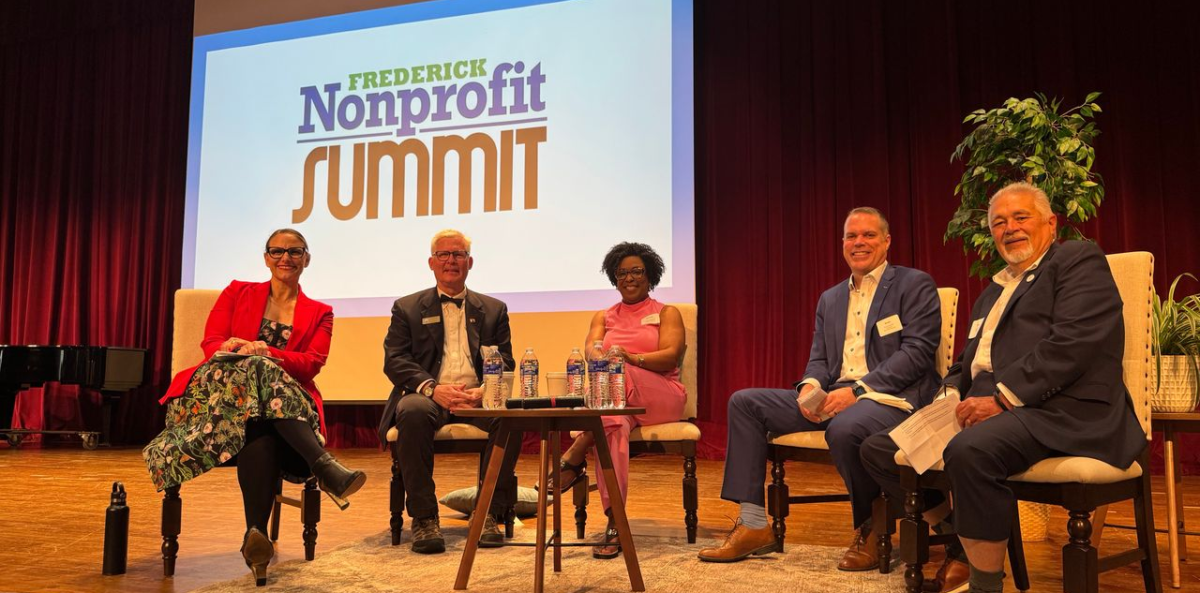
It was not that far – three hours in the car – and I arrived in Frederick, Maryland. I had been told it was a very engaged, collaborative, and supportive community. One person told me, “If you don’t want to be involved in the local community, don’t move to Frederick.”
And deciding to move to Frederick is something a lot of people do. It’s the second largest city in Maryland, and one where I was told many military families – who have traveled extensively – decide to settle in.
I was there as the keynote speaker for the annual Nonprofit Summit, which was held at Frederick Community College (FCC). It’s said that one in five residents attends FCC, so the institution is a big part of the community.
Almost as soon as I arrived, what I had been told proved to be true.
Engaged? Hundreds of people signed up for this conference and were joyously coming into the building to participate in the summit. When the organizers asked if there were people not even from Frederick, about a dozen people raised their hands. The crowd was active and asked thoughtful questions.
Collaborative? This was a crowd that was totally together. Funders, nonprofit leaders, corporate supporters, board, staff, mixing and mingling. The host committee wore capes because the Nonprofit Leadership Lab believes all nonprofit leaders are superheroes, and “The world is counting on us.” The host committee members were representative of different groups in the larger community. There was no special green room or separate place for VIPs. Everyone was treated like they were Very Important.
Supportive? I was invited to one funder’s son’s birthday party the next weekend, and I actually wanted to go. These folks want to connect and support each other, and they make it happen. When a specific organization was publicly highlighted, everyone clapped. Hoping-to-be elected officials together with local community leaders and foundation funders for a more intimate conversation. The topic was, “How can we be even better partners to each other?” And even more amazing, that is what was actually and tangibly discussed.
Now, I don’t know about you, but I have been in the nonprofit world for decades, and what I witnessed at this summit in Frederick is what anyone would want for their own community – holistic and productive collaboration – but it RARELY gets achieved.
So, how did they do it? That’s what I wanted to know, and here’s what I found.
Three Ingredients for a Collaborative, Thriving Nonprofit Ecosystem
1. They know their collective power, and they leverage it!
The local chamber of commerce has a nonprofit alliance, and they worked to highlight and center the power of Frederick’s nonprofit sector. According to them, nonprofits contribute $1.03 BILLION to the local economy. Volunteers provide $42 MILLION in unpaid service hours to local organizations, and the sector makes up 13% of the area’s workforce.
And when it came time to meet with local elected officials, the attitude of the community organizations was not one of simple celebration and humble gratitude for the local government funding they receive, but one of “We have power too. How can we work together to make it better for everyone?” It made for a very productive conversation.
2. They cultivate partnership and collaboration.
When I was working with the planning committee to come to Frederick, one of the members shared a story of another foundation, not in the area, asking about how they could connect with the local community. This person said something like, “I told them if that’s how you are thinking of it, that’s part of the problem.”
Foundations are not SEPARATE from the community; they are part of the community. And though probably many/all of us would agree with that, I have seen way too many times, especially in bigger cities, that this belief is not practiced nearly enough. I saw something very different in Frederick.
3. They believe in capacity-building and leadership development, for real.
This is the 13th year of the summit, and it’s sponsored by local foundations and businesses, making it accessible to nonprofits, their volunteers, and board members. People were provided breakfast and super fun stickers asking them, “What is your Superpower?” with room to fill in the blank. A local businessman and former nonprofit leader bought Joan Garry’s book on Nonprofit Leadership for ALL of the attendees.
This is not a community that gives lip service to building the capacity of its nonprofit leaders; it actually thoughtfully puts time, energy, and funding into teaching and inspiring its local leaders. Every year.
I’m not trying to paint a utopia – no town or city is perfect – but I am trying to explain the mindset and behavior of folks in this community who genuinely want to work together to make it better for all.
It seems to me like these things would not be hard for any other community to adopt. You could start by asking yourself these questions:
- Who needs to be at the table on any local issue? Who is missing? Who can convene this group and how often?
- Am I building long-term relationships across the sector in my local community?
- What are the ways that I am helping to connect us? Are there ways I am unintentionally separating us or making it “less welcoming?”
After visiting Frederick, I thought back to my sister, who lives in Baltimore, and I joked (some truth to it though) that I was going to try to convince her to move to Frederick in no small part because of the thriving nonprofit ecosystem. And also, selfishly, because I would like to go back and visit.
For me, the bottom line is that we hear a lot of tough and discouraging things right now in the news, and I firmly believe we don’t hear enough about the good that is actually happening, perhaps more quietly, but persistently.
At lunch, someone heard that there was another nonprofit gathering in D.C., and they had to have security because they received threats. Threats?! Against the people working to make the world better, most for little to no compensation? The juxtaposition was not lost on me.
I wanted to raise this good news and try to share some of the secret sauce/recipe I witnessed for spreading it, because it seems possible for this to exist in more communities across the country, and I guarantee that would make it better for everyone.
So I want you to dream – or dare I say, manifest – with me, dear reader: What would it take for your community to have some of what Frederick is having? Please share!