There are many reasons board members say “enough.” Maybe they didn’t understand all the obligations. Maybe it’s a bigger job than they imagined. Perhaps they don’t feel they are adding value.
Maybe the meetings are poorly run, or the agendas are not well constructed…
Perhaps the chair is not a seasoned facilitator and finds it difficult to navigate the voices around the table. The quiet board member stays quiet. The executive director gives board members no option to offer guidance or insight.
But there is one seemingly small thing that can really cause valuable board members to check out (figuratively or literally)
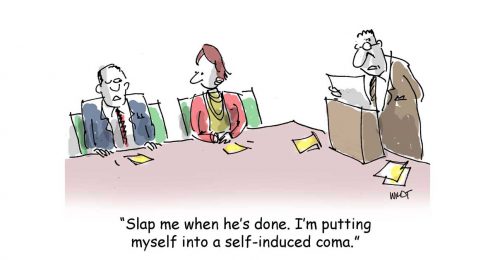
The board conversation dominator.
I like to think I have not been characterized this way when I have been part of a nonprofit board (as I am a talker). But I’m also a pretty good listener, and I can read a room.
Let’s talk about the three varieties of long-winded board members::
- A person who does indeed have interesting things to say, unique and perhaps valuable. But everyone at the table realizes the clock will tick out, and other voices will be silent. These folks can, in fact, be the smartest people in the room. And they know it. They believe people really like to hear them talk.
- A person who believes the more they talk, the more important they are and the more valued the point of view. Even if it isn’t true. These people are unaware that everyone has tuned them out. These folks seem to like to hear themselves talk.
- The person who is insecure and may not really have any thoughts of their own, so they jump on the comments of the prior speaker and just repeat those comments. These folks will embellish the insights already shared, so there is just the faintest whiff of original thought.
The frustration that builds up with the other board members (the non-long-winded folks) is two-fold: first, other board members get no airtime, but, more importantly, nothing is done to change the dynamic.
In fact, it seems to be accepted. “Well, you know that Suzie just likes to talk….”
The root of this problem is that board chairs, E.D.s, and other board members have no strategies to course correct
So the two big questions we pose today are:
- Who is responsible for fixing this before you lose great board members who are not bald because they have pulled out all their hair?
- What strategies can be employed to grab back ownership of the meeting?
WHO IS RESPONSIBLE?
The simple answer: the board chair.
The board is accountable to the chair. It is the chair’s job to make sure that there is a solid, diverse group of people who understand their role and are accountable for fulfilling their responsibilities.
This is news to many board chairs, especially those elected because no one else raised their hands. The board chair is to create an entity that partners with the staff to be thought partners, identify resources, and be ambassadors and champions for the organization. Too many board chairs think their job is to supervise the executive director or, conversely, to support the executive director so they are happy and don’t leave (often regardless of performance).
DEFLATION STRATEGIES
1) Recruit Board Members with Leadership and Facilitation Skills
There will be talkers on every board. Hopefully, you can weed out some during the recruitment process, but in addition, you need board members who will gently interrupt, facilitate well, and show up as leaders to ensure that all voices are heard.
2) Be Clear About The Role of the Chair
They must be great facilitators – treating all board members with respect and ensuring that each board member is valued and HEARD. And as we know, conversation dominators can thwart the ability to hear from everyone. That is what leadership looks like – model the behavior you want to see in your team and introduce accountability.
TECHNIQUES FOR “IN THE MOMENT” DEFLATION
1) Preemptive Strike
When you become the board chair, make an opening statement at your first board meeting. Include talking points such as:
- We are a team that exists to partner with, support, and provide oversight to the organization.
- You have agreed to be a leader and an ambassador for our organization, and to spread the word about our work to bring more people to it.
- I commit to using your time well and to valuing your voices.
- Meetings will be designed to maximize what you learn, to enrich you, and to excite you about this work.
- I will lead these meetings with care, ensure that quiet folks have the opportunity to speak up, and that those with lots to say will leave room for the others.
- I consider it my job to make this experience a valuable one for you and to ensure that our board adds real value to the organization.
2) Build Ground Rules Together
As part of this first meeting, the board chair should craft ground rules but NOT impose them on the group. They should be designed together.
So, as part of your first meeting as chair, build ground rules together. Here are some to consider:
- Meetings will begin and end on time unless we all agree we need more time at the end.
- If you agree with a colleague, don’t repeat. Just say “ditto.”
- Let’s agree on what happens if someone overtakes the conversation – goes on too long. One option is for me (if meeting is in person) to stand up and walk over to that person.
- No phones, but have 2 built-in breaks.
- If you have to take a call, I will assume it is a family member – go off camera or leave the room.
These are some examples. The object of this exercise is to agree on the ground rules together. What that means is the chair is not the only one who can make a note that someone has crossed a boundary, and that all board members have the agency to raise a concern. When you do this, the meeting ground rules belong to everyone. That is a collaborative leadership style that is ideal for volunteer management.
3) In the Moment
Ok, so it happens (and it will). Conversation dominators of any variety will not be quite self-aware enough to catch themselves. Here are a few techniques to use in the moment.
And while it is the easy way to let the chair lead, if you have built the ground rules together, everyone should feel able to identify a challenge. Some of these techniques work best coming from the chair; others can come from colleagues as well.
- Name It
“Bob, I am going to interrupt you.” Use their name – it will catch their attention and give them pause. And use the word interruption. It’s ok, it’s not a criticism – you just want in. Then indicate that you want to add something, respectfully disagree, or ask another question in the room (easier for a chair, but could be any board member). - “Let’s Hear From Everyone”
This is one of the board chair’s biggest jobs. This kind of statement goes a long way to validating other board members, affirming their value. They will feel supported, they will understand that you are holding the conversation dominators accountable, and they will be more likely to speak up.
THE BEST ADVICE I CAN GIVE YOU
- Design a Board Meeting That Ignites Engagement
As board chair, it is your job to partner with the E.D. to craft a meeting that does not just inform (“show and tell”) but also enriches and engages board members.
There are staff leaders who believe board members should be kept at arm’s length from offering input into strategies. Those staff leaders have not done enough to enrich and inform board members so that their input has real value and the perspective they bring based on their backgrounds, expertise, and lived experience. Do not let the E.D. alone drive the agenda. Be a partner and make sure it serves the needs of the board as well as the needs of the staff. Perhaps the biggest complaint from board members? “No one asked my opinion about anything – I could have called in.”
If you can design a great board meeting, and you can all own the ground rules that avoid the challenges presented by conversation dominators, you are on your way to a fully engaged board. Board members who will be anxious to be enthusiastic ambassadors, ready to get out there, tell stories, and invite more folks to come closer to the work.
And that is the secret sauce of an engaged board, and the sign of a five-star board chair.